Solids, Liquids, and Gases: Why Some Fluids Can Even Crack Like Glass
5 min read / 2026-07-12
Learn what really separates solids from liquids, and why scientists were surprised to see an ordinary fluid crack like glass instead of flowing smoothly.
What it means
Every material is made of tiny particles that are always moving. In a solid, like an ice cube or a glass window, the particles are packed tightly and held in place, so the material keeps its shape unless a strong force breaks it. In a liquid, like water or honey, the particles can slide past each other, so the liquid flows and takes the shape of its container. In a gas, particles move freely and spread out to fill any space. This basic idea is called the states of matter, and scientists use it to predict how materials will behave.
How it works
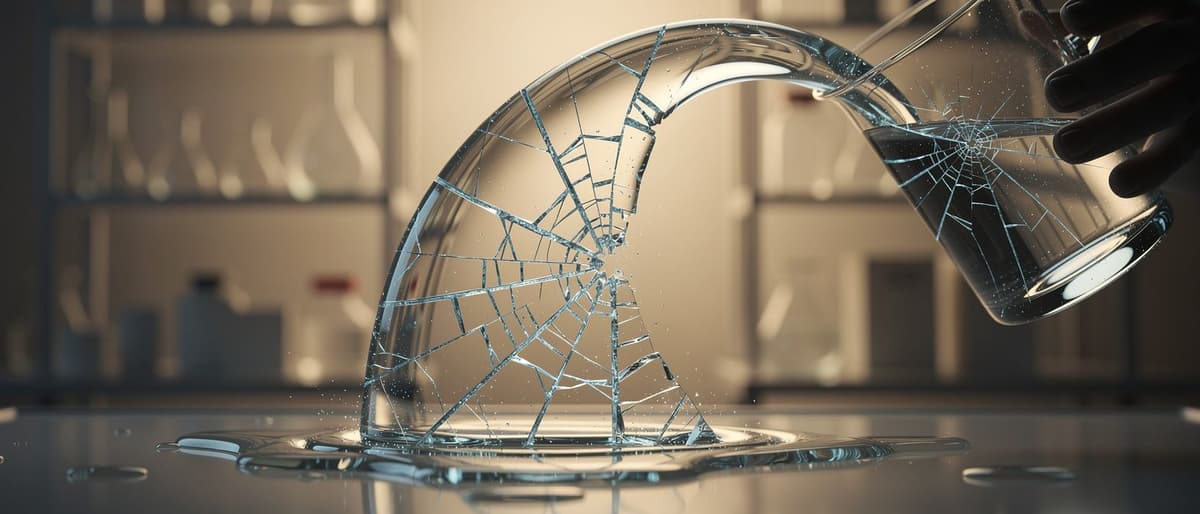
Solids can crack because their particles are locked into a stiff structure. When you push or pull a solid too hard, that structure snaps instead of bending smoothly, creating a crack. Scientists believed only materials with 'elasticity,' meaning they can stretch and spring back like a rubber band, could crack this way. Liquids were thought to only flow, never crack, because their particles are not locked in place. That is why physicists were surprised when they stretched a plain fluid, one with zero elasticity, very quickly and watched it split into clean crack lines, just like glass breaking.
A simple example
Think about pouring honey slowly versus flicking it fast off a spoon. Poured slowly, honey stretches and drips smoothly, behaving exactly like a normal liquid should. But if you could stretch a liquid fast enough, physicists found it can suddenly snap apart into sharp edges instead of stretching into a thin thread. This is similar to how a metro train can glide smoothly at normal speed but jolt passengers if it suddenly brakes hard, sudden, fast forces can make something behave very differently than it does when moved slowly.
Why people talk about it
For decades, textbooks taught that fracturing, or cracking, needed elastic 'memory,' a material's ability to remember its original shape and spring back. This discovery breaks that rule for a simple fluid with no springiness at all. Scientists care because industries like oil drilling, 3D printing, and food processing rely on liquids behaving predictably under stress. If fluids can crack unexpectedly, engineers may need better models to avoid problems, like a drilling fluid suddenly failing deep underground instead of flowing as expected.
What to remember
Matter is usually sorted into solids, liquids, and gases based on how tightly particles are packed and how easily they move. But real materials do not always follow simple rules, especially under fast, extreme forces. This new finding shows that even a basic liquid can crack like a solid if stretched quickly enough, reminding scientists that nature often has surprising exceptions to rules that seemed settled.
Key words
States of matter
The basic forms materials take, mainly solid, liquid, and gas, based on how their particles are arranged and move.
Elasticity
A material's ability to stretch or bend and then spring back to its original shape.
Fracture
When a material cracks or breaks apart instead of bending or flowing smoothly.
Key facts
- 1Solids, liquids, and gases are called the three common states of matter, based on how their particles are arranged and move.
- 2Physicists previously believed only elastic materials, ones that stretch and spring back, could fracture or crack under stress.
- 3A recent experiment showed a simple fluid with zero elasticity still cracked into clean lines when stretched very quickly.
- 4Speed matters a lot: the same fluid can flow smoothly when moved slowly but crack when stretched fast enough.
- 5Better understanding of fluid cracking could help industries like oil drilling, 3D printing, and food manufacturing avoid unexpected failures.
Why it matters
Knowing how matter behaves under stress helps engineers design safer drilling equipment, 3D printers, and food processing machines that use liquids.
Sources
- Quanta Magazine
- Simons Foundation