Dark Matter and Dark Energy: What Makes Up 95% of the Universe?
6 min read / 2026-06-24
About 95% of the universe is made of things scientists cannot see or touch directly — dark matter and dark energy. This explainer helps you understand what they are, how scientists know they exist, and why physicists are racing to unlock their secrets.
What it means
When you look at the night sky, you see stars, planets, and galaxies. But all of that visible stuff — everything made of atoms, including you, Earth, and every star — adds up to only about 5% of the universe. The rest is split between two invisible things: dark matter (roughly 27%) and dark energy (roughly 68%). 'Dark' here does not mean gloomy or scary. It simply means we cannot see it with any telescope, because it does not emit, absorb, or reflect light. Scientists know these things exist because of the effects they have on things we can see — a bit like knowing the wind exists even though you cannot see it, only feel it bending the trees.
How it works
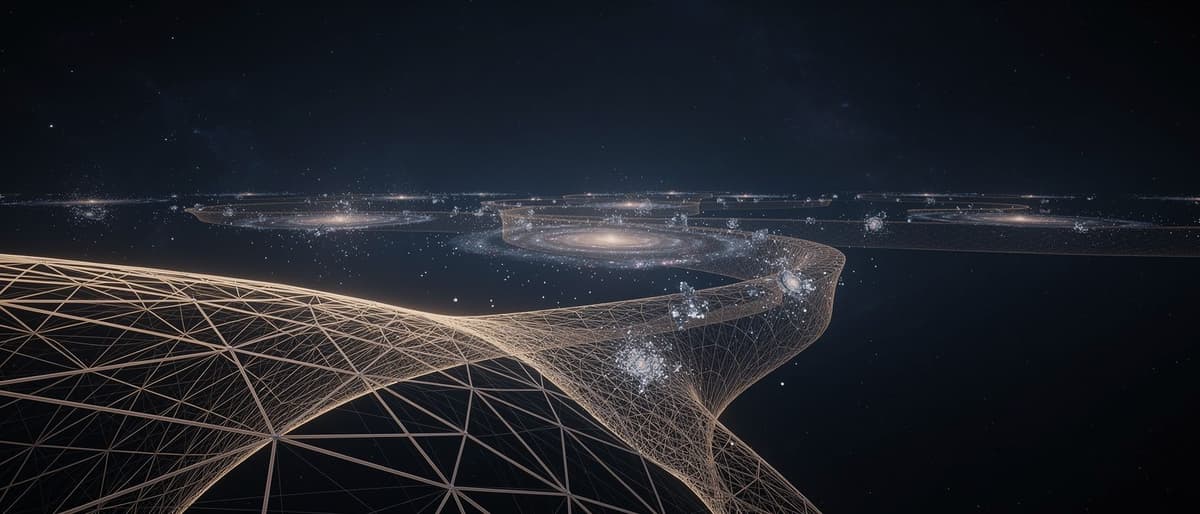
Dark matter is a kind of invisible substance spread through and around galaxies. It has gravity, which means it pulls things together. Without it, galaxies would spin apart — the stars on the outer edges move too fast to stay in place unless something extra is holding them. Dark matter acts like an unseen scaffolding that keeps galaxies intact. Dark energy is different. Instead of pulling things together, it is a mysterious force (or property of space itself) that pushes the universe to expand — and that expansion is speeding up over time. Think of the universe like a balloon being blown up. Dark energy is what keeps pumping air into it, faster and faster. The two are very different in what they do, yet both are invisible and both make up the vast majority of everything that exists.
A simple example
Imagine a merry-go-round at a playground. If children sit only near the centre, the ride spins normally. But if children sit near the edges and the ride is spinning very fast, they should fly off — unless something is holding them. Dark matter is like invisible safety belts gripping those outer seats. Now imagine the playground itself is slowly stretching — the distance between the swings, the slide, and the merry-go-round keeps growing, and it grows faster every year. You cannot see what is stretching the playground. That invisible stretching force is like dark energy. Scientists measure both effects very carefully using telescopes and the motion of distant galaxies.
Why scientists talk about it
For decades, physicists treated dark matter and dark energy as two completely separate mysteries. But recent observations from the DESI telescope — which maps millions of galaxies across the sky — suggest dark energy is not a fixed constant. It appears to have changed over time. This is a big deal because the standard model of cosmology (the accepted rulebook for how the universe works) assumed dark energy was constant, like a steady background hum. If dark energy changes, some theorists now ask: could dark matter also be slowly changing? And if both are changing, might they share a single origin — perhaps something as exotic as an extra hidden dimension of space that we cannot detect yet? This is still a hypothesis, not a proven fact. But it is the kind of bold question that drives new experiments and telescope missions like the European Space Agency's Euclid spacecraft.
What to remember
Dark matter and dark energy are not science fiction — they are conclusions drawn from decades of careful observations by institutions like NASA and the European Space Agency. Dark matter holds galaxies together through gravity. Dark energy drives the universe to expand faster and faster. Together they make up about 95% of everything. Scientists have never directly detected either one in a laboratory, which is why they remain the biggest open questions in physics. New instruments like DESI and the Euclid mission are collecting data right now that could reshape our understanding within the next decade or two.
Key words
Dark matter
An invisible form of matter that does not emit or absorb light but exerts gravity, helping hold galaxies together.
Dark energy
A mysterious force or property of space that causes the universe to expand at an ever-increasing rate.
Cosmology
The branch of science that studies the origin, structure, and large-scale behaviour of the universe.
DESI
The Dark Energy Spectroscopic Instrument, a telescope in Arizona that maps millions of galaxies to study how the universe has expanded over time.
Key facts
- 1About 27% of the universe is thought to be dark matter, and about 68% is dark energy — leaving only around 5% as ordinary visible matter.
- 2Dark matter was first strongly proposed by Swiss astronomer Fritz Zwicky in the 1930s after he noticed galaxy clusters moved as if they had far more mass than was visible.
- 3Dark energy was discovered in 1998 when two teams of astronomers found that distant supernovae were farther away than expected, meaning the universe's expansion is accelerating.
- 4The DESI (Dark Energy Spectroscopic Instrument) telescope in Arizona has mapped over 6 million galaxies to study how dark energy has behaved over billions of years.
- 5No particle detector or telescope has directly captured a dark matter particle or dark energy quantum — scientists infer both entirely from their gravitational and cosmic effects.
Why it matters
Understanding dark matter and dark energy would complete our picture of the universe and could lead to entirely new physics beyond what Einstein described.
Sources
- DESI (Dark Energy Spectroscopic Instrument) collaboration — desi.lbl.gov
- Euclid Space Mission, European Space Agency — esa.int/Euclid
- NASA Science — Dark Energy, Dark Matter — science.nasa.gov