Science
Nobel physics prize honours Francis Halzen's hunt for cosmic particles
AI-generated illustration · not to scale
A telescope buried in Antarctic ice catches tiny particles from deep space. Francis Halzen has won the 2026 Nobel Prize in Physics for helping make that unusual observatory, IceCube, a reality.
1 km³the volume of Antarctic ice instrumented by the original IceCube detector
The facts
- 1The Royal Swedish Academy of Sciences announced Halzen's award on 6 October. It recognises his work on IceCube and the discovery of high-energy neutrinos from beyond our solar system.
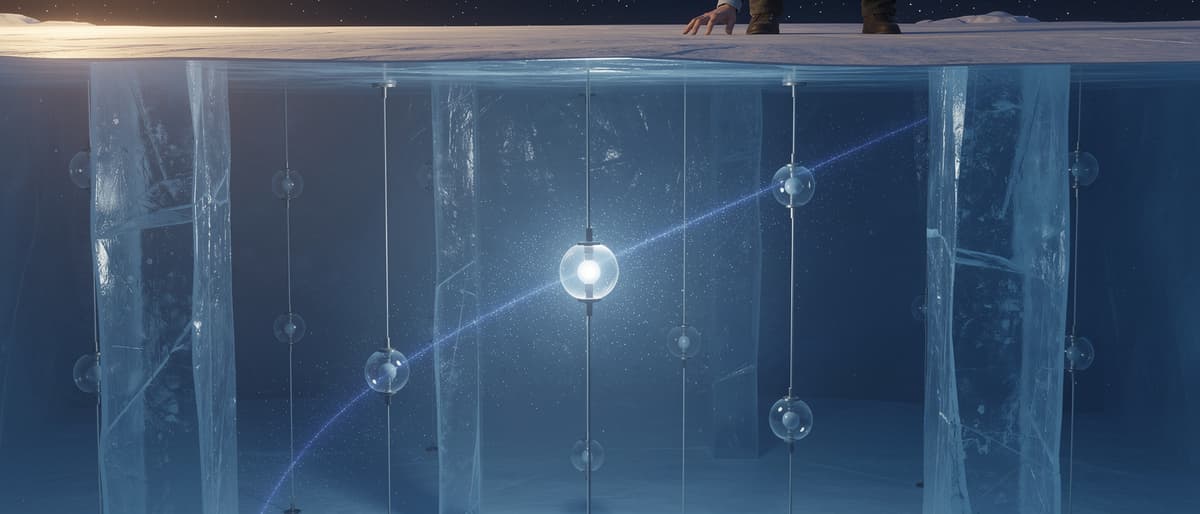
- 2Neutrinos are tiny particles that usually pass straight through matter, including Earth. On rare occasions, a collision in the ice creates other particles that give off light. IceCube's buried sensors record that light.
- 3The original detector spreads 5,160 light sensors through one cubic kilometre of ice. That huge volume gives it more chances to catch the rare interactions, rather than letting almost every neutrino slip past unnoticed.
- 4The international IceCube team published evidence for high-energy cosmic neutrinos in 2013. The discovery depended on years of work by researchers, engineers and Antarctic crews; it was not an experiment completed this week.
- 5Unlike electrically charged particles, neutrinos are not deflected by magnetic fields. Their light patterns in IceCube help the team estimate their direction and energy, offering clues to where they came from.
Why it matters
Looking at space does not have to mean collecting starlight. Neutrinos carry another kind of evidence about distant cosmic events, helping astronomers investigate places and processes that light alone cannot fully reveal.