Science
Why Physicists Think Gravity Could Be a Hologram of Reality
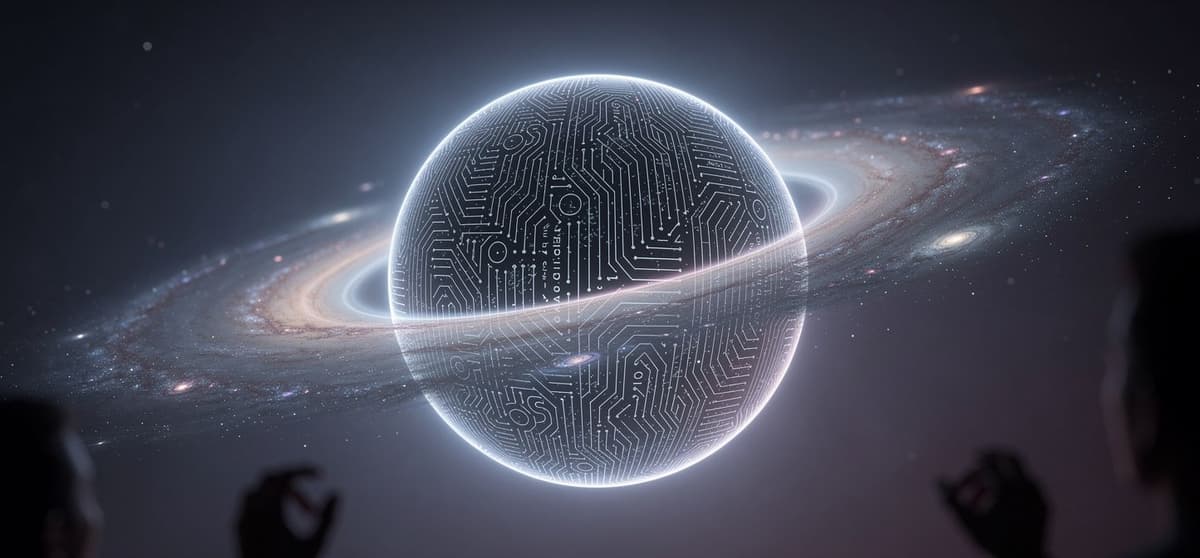
Gravity may not be a fundamental force at all: a growing line of theoretical physics suggests our three-dimensional universe's information could be fully encoded on a distant two-dimensional boundary, like a hologram, reshaping how physicists think about space itself.
1997Year Maldacena proposed AdS/CFT correspondence
The facts
- 1The holographic principle proposes that all information within a three-dimensional volume of space can be fully encoded on its two-dimensional boundary, like a hologram.
- 2The idea grew from black hole physics, where physicists Jacob Bekenstein and Stephen Hawking found a black hole's information capacity scales with its surface area, not its volume.
- 3In 1997, physicist Juan Maldacena proposed the AdS/CFT correspondence, a mathematical model showing a gravity theory in a volume matches a quantum theory without gravity on its boundary.
- 4This suggests gravity may not be a fundamental force but an emergent effect arising from quantum entanglement among particles described on a boundary surface.
- 5The framework remains largely theoretical, tested mostly in simplified model universes, and no experiment has yet confirmed it holds for our actual universe, according to Quanta Magazine.
Why it matters
If confirmed, this would mean space-time itself emerges from quantum information rather than being a fixed backdrop, changing how physicists search for a unified theory of gravity and quantum mechanics.
Sources
- Quanta Magazine
- Institute for Advanced Study
- Kavli Institute for Theoretical Physics